

What Do Cats Say to Each Other? How Cats Communicate
Have you ever watched two cats stare at each other across the room and wondered what they're saying? Maybe one gives a little chirp, the other slowly blinks, and suddenly they're rubbing noses like old friends. Or perhaps one cat flicks their tail, flattens their ears, and makes it very clear that company isn't welcome!
Cats may not have conversations the way humans do, but they have a surprisingly sophisticated communication system. They use body language, facial expressions, scent, touch, and a variety of vocalizations to share information with other cats. And while we tend to notice the meows, some of their most important messages are completely silent.
So, what do cats actually say to each other? Do they meow at their feline friends, recognize one another's voices, or have special ways of showing affection? Let's explore the fascinating world of cat-to-cat communication and learn how to better understand what our furry companions are telling each other.
How Do Cats Communicate With Each Other?
Cats communicate through several different channels, often using more than one at the same time.
A friendly greeting might involve an upright tail, a soft trill, and a gentle rub against another cat. A warning might include a stiff posture, flattened ears, a growl, and a rapidly moving tail.
These signals help cats communicate their intentions, maintain social relationships, establish boundaries, and avoid unnecessary confrontations.
Understanding feline communication means looking at the whole situation rather than interpreting one sound or movement in isolation. A purr, for example, doesn't always mean happiness, and a hiss doesn't necessarily mean a cat is naturally aggressive. Context matters.
Do Cats Meow at Other Cats?
Yes, cats can meow at other cats, but adult cats generally use meowing more frequently when communicating with humans.
Over time, domestic cats have learned that meowing is an effective way to get our attention. We respond by feeding them, opening doors, offering affection, or investigating whatever has captured their interest.
Among adult cats, communication often relies more heavily on body language, scent, touch, and other vocalizations.
However, that doesn't mean adult cats never meow at one another. Vocal behavior varies by individual, situation, and social relationship. Some cats may meow during encounters with other felines, particularly when excited, frustrated, or seeking attention.
The important distinction is that meowing isn't the primary language adult cats use with one another.
Why Do Kittens Meow at Their Mothers?
Meowing plays a particularly important role early in a cat's life.
Young kittens use vocalizations to communicate needs and distress to their mothers. A kitten may call when hungry, cold, separated from the litter, or uncomfortable.
Mother cats respond to their kittens using a variety of sounds and behaviors, including vocalizations that help maintain contact.
As kittens mature, their communication patterns change. Adult cats continue using vocal sounds, but their social interactions increasingly involve other signals.
This helps explain why the statement that cats only meow at humans is an oversimplification.
What Do Different Cat Sounds Mean?
Cats have an impressive vocal repertoire. Some sounds are associated with friendly interaction, while others communicate discomfort, fear, or the need for distance.
| Cat Sound | Possible Meaning |
|---|---|
| Trilling | Friendly greeting or social contact |
| Chirping | Social excitement or response to prey |
| Purring | Contentment, social contact, or self-soothing |
| Hissing | Fear, discomfort, or a warning to back away |
| Growling | Threat, defensiveness, or guarding space |
| Yowling | Distress, mating behavior, or conflict |
These are general patterns rather than exact translations. To understand what a cat is communicating, pay attention to the circumstances and accompanying body language.
Trilling: A Friendly Greeting
A trill is a short, rolling sound that falls somewhere between a chirp and a purr.
Mother cats may use trills when interacting with their kittens, and adult cats can use similar sounds during friendly social encounters.
If one cat approaches another with an upright tail and a soft trill, the combination may suggest a friendly greeting. Some cats also trill when approaching their human companions.
For more about this distinctive sound, read All About Cat Trilling.
Chirping and Chattering
Chirps are short, high-pitched sounds that cats may produce in different situations.
Some are used during social interactions, while the familiar chattering sound is often heard when a cat watches birds or other prey through a window.
Not every chirp has the same meaning, so observe what your cat is doing and how other cats respond.
Purring
Purring is commonly associated with comfort and contentment, particularly when cats are resting together or receiving affection.
However, cats may also purr when stressed, uncomfortable, or unwell. A cat purring while curled up beside a familiar feline companion may be relaxed, but the sound alone doesn't prove happiness.
Learn more in our article about why cats purr.
Hissing
A hiss is generally a defensive warning.
When one cat hisses at another, they're often communicating discomfort, fear, or a desire for more space.
A hiss doesn't necessarily mean a fight is about to happen. In fact, it can help prevent conflict by telling the other cat to back away.
If your cats are hissing at each other, give them space rather than forcing an interaction.
Growling
Growling is another warning vocalization that may occur when a cat feels threatened, frightened, or protective of a resource.
A growling cat may be telling another animal to stay away from food, a resting place, or personal space.
Watch for accompanying signs such as a stiff body, flattened ears, or an intense stare.
Don't punish a cat for growling. The sound is useful communication that tells you the cat is uncomfortable.
Yowling and Caterwauling
Yowling is typically louder and more prolonged than an ordinary meow.
Cats may yowl during territorial disputes, mating-related behavior, or stressful encounters.
Sudden or persistent yowling can also be associated with medical problems, particularly in older cats. If your cat begins vocalizing unusually, a veterinary examination may be appropriate.
How Cats Communicate Through Body Language
Much of feline communication happens without a sound.
Cats use their tails, ears, eyes, whiskers, and overall posture to communicate how they're feeling. These signals are especially important when two cats are deciding whether to approach, play, retreat, or avoid each other.
Tail Position
An upright tail is often associated with a friendly approach, particularly when the cat's body is relaxed.
A puffed-up tail may indicate fear or arousal, while a tail held tightly against the body can signal insecurity or discomfort.
Rapid tail movements may indicate agitation, although tail behavior must always be interpreted alongside other signals.
Ear Position
Relaxed ears that face forward or move naturally are often seen during calm interactions.
Ears turned sideways or flattened against the head may indicate fear, irritation, or defensiveness.
If one cat approaches another with flattened ears and a tense posture, the interaction may not be friendly.
Eye Contact and Slow Blinking
Direct, prolonged staring can be threatening in some feline interactions, particularly when accompanied by a stiff posture.
Soft eyes and relaxed blinking are more commonly associated with calm behavior.
Slow blinking is often discussed as a friendly signal between cats and humans, although its precise meaning in every cat-to-cat interaction isn't fully understood.
Body Posture
A relaxed cat typically moves naturally and appears comfortable in their surroundings.
A frightened cat may crouch, make themselves smaller, or attempt to escape.
A cat trying to appear threatening may arch their back, raise their fur, and turn sideways to look larger. These postures help other cats assess whether an encounter is safe.
Why Do Cats Rub Against Each Other?
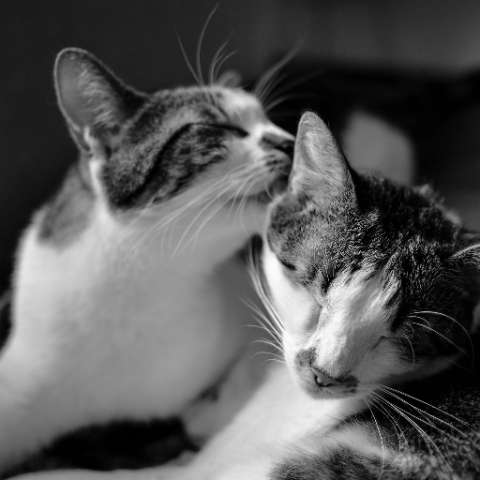
When cats rub their cheeks, heads, or bodies against one another, they're engaging in a behavior known as allorubbing.
This behavior is commonly seen between cats that have a friendly social relationship.
Cats have scent-producing glands around parts of their faces and bodies. Rubbing can help exchange and distribute familiar scents within a social group.
You'll often see bonded cats rub against each other when greeting after spending time apart. Some cats also rub against their human companions, furniture, and other familiar objects.
Although rubbing can be a friendly behavior, its meaning depends on the overall interaction.
How Cats Communicate Through Scent
Scent is one of the most important forms of feline communication, even though humans often don't notice it.
Cats use scent information to recognize familiar environments, identify other animals, and communicate aspects of their presence and reproductive status.
They deposit scent through rubbing, scratching, and urine marking. These scent signals can remain after a cat has left an area, allowing other cats to gather information without a direct encounter.
Facial Scent Marking
When a cat rubs their cheeks against furniture, doorways, or another cat, they may be depositing scent from facial glands.
This is a normal part of feline behavior.
Scratching as Communication
Scratching doesn't just help cats maintain their claws. It also leaves visible marks and scent information from glands associated with the paws.
Providing appropriate scratching surfaces allows cats to engage in this natural behavior.
Urine Marking
Some cats communicate through urine marking, particularly in territorial or socially stressful situations.
However, inappropriate urination can also indicate a medical problem. If your cat begins urinating outside the litterbox, don't assume they're simply marking territory. A veterinary evaluation may be necessary.
Do Cats Recognize Each Other by Smell?
Yes, scent plays an important role in how cats identify and respond to familiar animals.
Cats that live together often develop a shared pattern of familiar odors through their environment and social interactions.
This is one reason a cat returning from the veterinarian may sometimes receive an unexpectedly unfriendly reception from another household cat.
The returning cat may smell different because of unfamiliar animals, disinfectants, medications, or the veterinary environment.
Giving cats time to settle and reintroducing them gradually when necessary can help reduce tension.
Why Do Cats Sniff Each Other?
Sniffing allows cats to gather information about another animal.
They may investigate the face, body, or rear of another cat during an encounter. These behaviors can help them assess familiarity and other scent-related information.
A brief sniff followed by relaxed movement may be part of an ordinary greeting.
But if one cat stiffens, retreats, hisses, or attempts to escape, the interaction may be uncomfortable. Allow cats to choose whether they want to approach rather than forcing them together.
Why Do Cats Groom Each Other?
When one cat licks another cat's head, ears, or neck, the behavior is called allogrooming.
It's often observed between cats that share a friendly social relationship.
Grooming may help maintain social bonds and can also assist with cleaning areas that are difficult for a cat to reach independently.
However, grooming doesn't always mean that two cats are equally comfortable with the interaction.
Sometimes one cat may become irritated, move away, or respond with a swat. Watch the entire interaction rather than assuming that every grooming session is affectionate from beginning to end.
Do Cats Have Friends?
Yes. Although cats are often described as solitary animals, domestic cats can form meaningful social relationships with other cats.
Some cats choose to sleep close together, groom one another, rub against each other, and engage in relaxed play.
These behaviors can suggest that the cats are comfortable together.
Other cats prefer more personal space and may peacefully share a home without becoming close companions. Neither arrangement is automatically a problem.
The goal in a multi-cat household is to ensure that each cat feels safe, has access to essential resources, and can choose when to interact.
If your cats have their own little friendship group, our Cat Friends Spiral Notebook is a fun way to celebrate the personalities that make each one special. Covered in cheerful cartoon cats, it's perfect for jotting down funny feline habits, memorable moments, and the little quirks that make your cats unique.
How Can You Tell If Two Cats Like Each Other?
Friendly cats may approach one another with relaxed bodies and upright tails, exchange gentle rubs, groom each other, or sleep nearby.
They may also play together, taking turns chasing or wrestling without sustained distress.
However, sleeping in the same room doesn't necessarily mean two cats are bonded. Some cats simply tolerate one another peacefully.
Likewise, cats that don't cuddle can still have a comfortable relationship. Look for voluntary interactions, relaxed body language, and the ability to share space without tension.
How Can You Tell If Cats Are Playing or Fighting?
Cat play can look surprisingly dramatic. Chasing, wrestling, pouncing, and gentle biting can all occur during normal play.
In balanced play, cats often take turns, pause naturally, and return to the interaction voluntarily.
Fighting is more likely when one cat repeatedly tries to escape, becomes trapped, or shows sustained defensive behavior.
Growling, intense hissing, flattened ears, and escalating aggression are warning signs. If an encounter becomes unsafe, separate the cats without placing your hands between them.
For more help understanding difficult interactions, see How to Handle Aggression in Cats.
Do Cats Understand Each Other's Meows?
Cats can detect and respond to vocal sounds from other cats, but researchers haven't established a direct translation system in which specific meows consistently represent particular words or sentences.
A cat may recognize familiar vocal patterns and respond differently depending on the caller, the sound, and the surrounding circumstances.
However, we shouldn't assume that one meow always means the same thing to every cat. Feline communication is highly contextual, and sounds are often accompanied by visual and scent information.
Do Cats Communicate Differently With Humans?
In some ways, yes.
Adult domestic cats commonly use meows when interacting with people, particularly when requesting attention, food, or access to something.
They also use many of the same signals they use with other cats, including rubbing, tail positioning, and vocalizations such as trills and purrs.
Over time, cats and their owners may develop familiar routines around particular sounds and behaviors. For example, you might recognize your cat's usual dinner-time meow or the distinctive trill they make when greeting you.
That doesn't mean cats understand human language in exactly the same way people do, but they can learn associations between sounds, situations, and responses.
Explore the topic further in Can Cats Understand What We Say?
And when words really do matter, sometimes the best way to communicate is the old-fashioned way. Our Cat Lady Greeting Card is a playful choice for sending a handwritten note to someone who understands that conversations about cats are never boring.
How Do Cats Communicate When They First Meet?
When unfamiliar cats encounter each other, they may assess one another through scent, posture, movement, and vocalizations.
Some cats approach cautiously and sniff. Others keep their distance while observing.
Hissing or growling may occur if a cat feels threatened or wants more space.
Contrary to a common misconception, unfamiliar cats don't necessarily greet each other by meowing. In fact, forcing two unfamiliar cats into immediate face-to-face contact can create unnecessary stress.
When introducing a new cat to a resident cat, gradual scent exchanges, controlled visual contact, and positive experiences are usually more appropriate than expecting an instant friendship.
Our guide to introducing a new cat to your resident cat explains the process in greater detail.
How to Encourage Positive Communication Between Your Cats
If you have multiple cats, their environment can make a significant difference in how comfortably they interact.
Provide enough food stations, water sources, litterboxes, resting places, and scratching surfaces so that cats don't have to compete for essential resources.
Allow each cat to retreat to a quiet area when they want personal space.
Vertical spaces, such as sturdy cat trees or accessible shelves, can help cats move through the home without constantly crossing one another's paths.
Interactive play can also provide positive experiences, but avoid forcing cats to participate together if one seems uncomfortable.
For additional enrichment ideas, read Keeping Your Cat Happy and Stimulated Indoors.
When Cat Communication Signals a Problem
Occasional hissing or disagreements don't necessarily mean that cats cannot live together peacefully.
However, repeated chasing, blocking access to food or litterboxes, hiding, injuries, or persistent fear can indicate a serious social problem.
A sudden change in how cats interact can also be associated with pain, illness, or changes in the household.
If previously friendly cats begin fighting or one cat becomes unusually withdrawn, schedule a veterinary examination and consider professional behavioral guidance.
Early intervention is generally easier than allowing ongoing conflict to become established.
Frequently Asked Questions About How Cats Communicate
Do cats talk to each other?
Yes. Cats communicate using body language, scent, touch, and vocalizations. Their communication doesn't function like human speech, but it allows them to share important social information.
Do cats meow at other cats?
They can, but adult cats generally use meowing more frequently with humans. When interacting with other cats, they often rely on body language, scent, and other sounds.
Why do cats meow at humans more than other cats?
Domestic cats can learn that meowing gets human attention and produces useful responses, such as food, affection, or access to a room. Learn more about how cats interpret human communication in Can Cats Understand What We Say?
Do kittens meow at their mothers?
Yes. Young kittens use vocalizations to communicate needs and distress, and mother cats respond with sounds and caregiving behaviors.
What does it mean when one cat trills at another?
A trill can be part of a friendly greeting or social interaction, particularly when accompanied by relaxed body language. Read All About Cat Trilling to learn more about this distinctive sound.
Why do cats chirp at each other?
Cats may produce short chirping sounds in social situations, but the meaning depends on the context. Chirping can also occur when cats watch prey.
Do cats purr to communicate with other cats?
Yes. Purring can occur during social contact, including interactions between mothers and kittens. However, purring isn't always a sign of happiness. Explore the different reasons in Why Do Cats Purr?
Why does my cat hiss at another cat?
Hissing is usually a defensive warning that communicates discomfort, fear, or a desire for distance. Give the cats space and avoid forcing contact. If conflicts continue, our guide to handling aggression in cats offers additional information.
What does growling mean between cats?
Growling often indicates that a cat feels threatened or wants another animal to stay away. It may occur during conflicts over space or resources.
Do cats recognize each other's voices?
Cats can distinguish and respond to vocal sounds, although the precise extent of voice recognition between individual cats depends on the circumstances and remains an area of research.
Can cats understand another cat's meow?
Cats can respond to vocalizations, but there isn't a proven word-for-word feline language in which every meow has a fixed meaning.
Why do cats rub their faces together?
Friendly cats may engage in allorubbing, which involves rubbing their heads or bodies together. This behavior can help maintain social relationships and exchange familiar scents.
Why do cats sniff each other?
Sniffing allows cats to gather scent information about another animal, including cues associated with familiarity and identity.
Why do cats lick each other?
Allogrooming, or grooming another cat, commonly occurs between cats with friendly social relationships. It may contribute to social bonding and grooming.
Do cats have a shared scent?
Cats living together can develop familiar scent patterns through their environment, rubbing, and social interactions. Scent is an important part of feline recognition.
Why does my cat hiss at another cat after a vet visit?
The returning cat may smell unfamiliar because of the veterinary environment. Allow the cats time to settle and use gradual reintroduction if necessary.
How do cats show affection to each other?
Friendly behaviors can include rubbing, grooming, relaxed approaches, and resting close together. Individual cats express social comfort differently.
How can I tell if my cats are bonded?
Bonded cats may voluntarily groom, rub against, sleep near, or seek out one another. Their interactions are generally relaxed and mutually comfortable.
Do cats need another cat to be happy?
Not necessarily. Some cats enjoy feline companionship, while others prefer living alone. Personality, social history, and the household environment all matter.
Why do cats stare at each other?
Staring can occur during observation, uncertainty, or social tension. A prolonged, rigid stare combined with a stiff posture may be threatening.
What does an upright tail mean when cats greet?
An upright tail is often associated with a friendly approach, especially when the rest of the cat's body appears relaxed.
How can I tell whether my cats are playing or fighting?
Play often includes pauses, role reversals, and voluntary reengagement. Fighting is more likely when one cat is frightened, trapped, or repeatedly trying to escape.
Can cats communicate without making noise?
Absolutely. Tail position, ear movement, body posture, scent marking, and physical contact are all important forms of silent communication.
Why do cats scratch objects to communicate?
Scratching leaves visible marks and scent information, making it one way cats interact with and communicate about their environment.
How can I help two cats communicate better?
Provide sufficient resources, safe resting places, opportunities to retreat, and gradual introductions. Avoid forcing interactions and seek veterinary or behavioral help for persistent conflict. Our guide to introducing cats offers practical steps for helping unfamiliar cats adjust to one another.
Learning to Understand Your Cat's Secret Conversations
Cats may never tell us exactly what they're thinking, but their communication is far more sophisticated than a simple meow. From the gentle trill of a friendly greeting to the unmistakable warning of a hiss, every sound, movement, and scent cue can help us understand how cats experience the world around them.
By watching your cats' tails, ears, posture, and interactions, you'll begin to recognize the difference between affection, curiosity, playfulness, and discomfort. You'll also learn that two cats don't have to cuddle constantly to have a peaceful relationship—and that even the friendliest feline sometimes needs a little personal space.
Those little conversations can make wonderful memories. Whether you're recording the first friendly trill between two cats, keeping a journal of their unique personalities, or writing down the funniest things they do, explore our Cat-Themed Notebooks & Journals for a place to preserve the stories you'll want to remember.
The next time your cats exchange a long look, a soft chirp, or a gentle head rub, pay attention. You might not understand every word of their conversation, but you'll be a little closer to speaking their language!
Leave a comment